hyperraum.tv: "Leben wir in einer deterministischen Welt, in der der Zufall nur unsere Unkenntnis der zugrunde liegenden Gesetze offenbart? Oder gibt es in unserem Universum Ereignisse „echten“ Zufalls? Mit zufallsgesteuerten zellularen Automaten zeigt der Physiker und Computerkünstler Herbert W. Franke, wie sich eine deterministische Welt von einer Welt mit echtem Zufall grundlegend unterscheidet – eine Frage, die nach heutigem Stand der Kenntnis niemals geklärt werden kann, da ihre Antwort in der Unendlichkeit liegt." Den Beitrag auf www.hyperraum.tv anschauen.
Franke wurde für seine Romane und Kurzgeschichten mehrfach mit dem Deutschen Science Fiction Preis und dem Kurd Laßwitz Preis ausgezeichnet. Links zu einigen seiner Kurzgeschichen habe ich in meinem zweiten Blog unter scifi.antville.org zusammengetragen.
WDR5, 2013: "Immer tiefer dringen Forscher in den Mikro- und den Makrokosmos; immer neue Forschungszweige entstehen: von Astrobiologie bis Quantenmechanik. Doch was bedeutet es, wenn naturwissenschaftliche Modelle immer unanschaulicher werden und alte Grenzziehungen verwischen?" Weiter
Wissen und behaupten (mp3)
WDR: "Der Physiker Klaus Eitel sucht in einem Gebirgstunnel nach den Beweisen für die Existenz der dunklen Materie; der "Geisterjäger" Kris Santa in einer Berliner Eckkneipe nach umherirrenden Seelen. Was unterscheidet Wissenschaft von Scharlatanerie?" Weiter
Labor und Welt (mp3)
WDR: "Immer teurer und komplexer werden die Experimente immer abstrakter die Theorie. Wird die Wissenschaft damit weltfremd und erzeugen Teilchenbeschleuniger wie das CERN gar ihr eigene Realität?" Weiter
Forscher und Laien (mp3)
WDR: "Charles Darwin, Wilhelm Herschel, Thor Heyerdahl, Alfred Wegener: sie alle waren Querdenker und Quereinsteiger, doch sie hätten im modernen Forschungsbetrieb kaum eine Chance. Wer darf vom Baum der Erkenntnis naschen?" Weiter
Hypothese und Hype (mp3)
WDR: "Zugespitzt formulieren und Zusammenhänge populär zu vermitteln das ist gewiss kein Nachteil für einen Hochschullehrer oder Institutsleiter. Aber: muss man den Klimawandel dramatisieren, um Forschungsmittel zu bekommen? Weiter
NZZ: "In ihrem Labor beobachteten die Forscher gehäuft, dass Mäuse oder Ratten weniger Schmerz zeigten, solange ein Wissenschafter im Raum war. Das wollten sie genauer untersuchen." Weiter
BBC: "Lisa Jardine traces the evolution of scientific endeavour in Britain over the last four centuries. We often hear how science has changed our world. In this series of seven programmes, Lisa explores how our world has changed science: pushing it in new directions, creating new disciplines and pioneering new approaches to scientific understanding. It’s a history of science that weaves science back into the fabric of everyday life and shows how the concerns of the scientist are the concerns of us all." Read on
Lisa Ma: "I was given the opportunity to stay in a joystick factory in China for a months with factory workers. The joystick factory has a problem -we don't buy joysticks anymore. In this film, we witness some of the insights and stories of the factory life, beyond the Western stereotypes, that led to a proposal of a part-time farming scheme for manufacturing industries."
SETI.org: "It is often said that mathematics is a universal language that we could use to make contact with another intelligence. But is that really the case? Or is this just a disguised version of anthropocentrism?" Read on
MDR: "Der Beginn der digitalen Revolution ist in der DDR mit dem Namen ROBOTRON fest verbunden. Der Chemnitzer Rolf Kutschbach gilt als der Vater der Rechentechnik in der DDR. In "GMD - Das Magazin" erzählt er von der abenteuerlichen Entwicklung des "R300" und verrät, warum der Rechner trotz internationaler Anfragen nicht in den Export kam." Zum Video
National Geographic: "The Brain Bank at Harvard, the world's largest repository where more than 7,000 human brains are donated, stored, and used for research."
BBC, In our Time: "Melvyn Bragg and his guests discuss the evolution of the Scientific Method, the systematic and analytical approach to scientific thought. It became a topic of intense debate in the 17th century, and thinkers including Isaac Newton, Thomas Huxley and Karl Popper all made important contributions. Melvyn Bragg is joined by Simon Schaffer, Professor of the History of Science at the University of Cambridge; John Worrall, Professor of the Philosophy of Science at the LSE and Michela Massimi, Senior Lecturer in the Philosophy of Science at University College London." Read on
sciencefriday.com: "Everything is a little bit magnetic, says physicist Richard Hill, of The University of Nottingham. So with a powerful magnet, it is possible to levitate almost anything--strawberries, water, insects. In a recent study, Hill levitated fruit flies to see how they behaved when they didn't have gravity pulling them down. (Credits: levitation video courtesy of Richard Hill) Viewed 13 times. See More Videos
Physicst Richard Hill and colleagues at the University of Nottingham have a powerful magnet that they have used to levitate fruits, beer and most recently, fruit flies. It’s a low-cost way to study the effects of zero gravity on biological systems, Hill says." Read on
"Astronomen wie Prof. Dr. Joachim Krautter von der Landessternwarte Königstuhl sehen im Trabanten der Erde aus gleich mehreren Gründen etwas ganz Besonderes im Sonnensystem. Vor allem aber fragen sich die Forscher, wie er entstanden ist. Gemeinsam mit der Erde aus dem protoplanetaren Nebel? Oder ließ er sich einst gravitativ von ihr einfangen? Wurde er aus der anfangs schnell rotierenden, flüssigen Erde abgespalten, mit dem Pazifik als noch heute sichtbarer Narbe? Oder war es doch ein Giant Impact, die Kollision mit einem marsgroßen Protoplaneten, aus welcher der Mond hervorging?"
Ist Verantwortung eine Illusion?
dradio.de: "Was wird aus Zurechenbarkeit und Schuldfähigkeit, wenn der freie Wille bloß ein frommer Wunsch ist? Verdient Strafe, wer nicht anders kann, als es seine Neuronen erlauben? Nicht nur Kriminelle und Psychopathen, sondern wir alle sind hirngesteuert." Weiter
Warum Menschen grausam handeln
dradio.de: "Das umstrittene sozialpsychologische Milgram-Experiment von 1961 demonstrierte, was der Mensch auch sein kann: banal und böse. Sich einer fremden Autorität willenlos zu unterwerfen, muss kein Automatismus sein. Doch wie lässt sich moralische Urteilsfähigkeit trainieren?" Weiter
Verbrechen, Schuld und Strafe
"Der Strafrechtler und Rechtsphilosoph Reinhard Merkel im Gespräch mit Barbara Bleisch. Seine These lautet: Die Erkenntnisse aus den Neurowissenschaften verändern unsere Wahrnehmung von Verantwortung und Schuld – und sollten auch im Strafrecht ein Umdenken zutage fördern." Weiter
Bettina Stangneth - Eichmann vor Jerusalem
"Ihr jüngstes Buch heißt in Anspielung auf Hannah Arendts berühmtes Buch Eichmann vor Jerusalem: Das unbehelligte Leben eines Massenmörders. Stangneth beschreibt das Leben und die öffentliche Wirkung des Massenmörders Adolf Eichmann bis zu seinem Prozess in Israel 1961. Sie beleuchtet Eichmanns Karriere und insbesondere die Zeit seines Exils in Argentinien. Es geht um sein Denken, seine Beziehungspersonen und die frühe Bundesrepublik. Stangneth zeigt, dass Eichmann mit seinem Exil nie zufrieden war, sondern nach Deutschland zurück wollte. Er war kein Bürokrat, sondern hat sich in Israel nur erfolgreich so getarnt, weil er das in Argentinien geübt hat. Eichmann habe in Jerusalem eine perfide Show abgezogen. Hannah Arendt sei wie nahezu alle anderen darauf hereingefallen." Weiter
Steven Pinker - Dradio - 21.10.2011
dradio.de: "Gewalt habe im Laufe der Geschichte abgenommen: Diese These stellt der Kognitionsforscher Steven Pinker in seinem neuen Buch Gewalt: Eine neue Geschichte der Menschheit auf. Darin beschäftigt er sich mit allen Formen der Gewalt: Krieg, Genozid, Mord, Todesstrafe, Folter oder Vergewaltigung." Weiter
"Im Jahr 1990 drehte sich die 1977 gestartete Raumsonde Voyager 1 auf eine Anregung von Carl Sagan hin zur Erde zurück, um eine Aufnahme unseres Heimatplaneten aus 6 Milliarden Kilometer Entfernung anzufertigen. Als "Pale Blue Dot" -- denn mehr als ein winziger, schwacher Lichtpunkt war nicht zu sehen - wurde die Fotografie weltberühmt. Mittlerweile aber erlaubt modernste Technologie, dass wir sogar Planeten um ferne Sonnen nachweisen können. In ihrem Kurzvortrag erklärt die Harvard-Astronomin Dr. Lisa Kaltenegger, die derzeit am Heidelberger Max-Planck-Instititut für Astronomie forscht, wie das gelingt und wie wir auf diese Weise sogar bewohnbare Welten finden können."
"Mars is often known as the 'Red Planet,' but is it really red? This 60-second video answers one of the most frequently asked questions about our planetary neighbor."
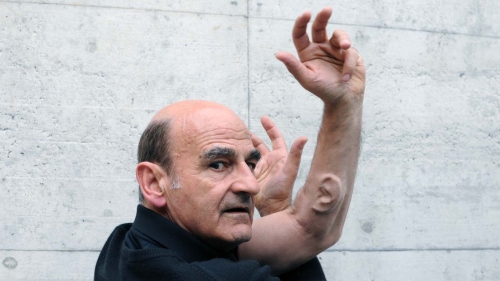
digitalbrainstorming.ch: "Er ist der Altmeister der Cyborgs: Seit über 30 Jahren arbeitet der australische Performance Künstler Stelarc an der Schnittstelle zwischen Mensch und Maschine. Auch in seiner jüngsten Arbeit setzt er dabei seinen eigenen Körper ein: Stelarc hat sich am Unterarm ein drittes Ohr opererieren lassen. Im Gespräch mit Dominik Landwehr erklärt er die Hintergründe seines Projekts (Englisch, 22 Minuten)" Weiter
BBC: "In September 2011, an international group of scientists has made an astonishing claim - they have detected particles that seemed to travel faster than the speed of light. It was a claim that contradicted more than a hundred years of scientific orthodoxy. Suddenly there was talk of all kinds of bizarre concepts, from time travel to parallel universes.
So what is going on? Has Einstein's famous theory of relativity finally met its match? Will we one day be able to travel into the past or even into another universe? In this film, Professor Marcus du Sautoy explores one of the most dramatic scientific announcements for a generation. In clear, simple language he tells the story of the science we thought we knew, how it is being challenged, and why it matters." Read on
"Join explorers and scientists, master photographers and adventurers at National Geographic Live — a lecture series featuring behind-the-scenes tales and magnificent images from one of the world's largest non-profit science and education foundations."
So far I have seen this two lectures:
Kakani Katija: Ocean Currents
"Can tiny sea creatures affect weather around the world? Emerging Explorer Kakani Katija looks to a new field of science for answers." Read on
swr.de: "Macht Google blöd und Facebook kindisch?" Weiter
Es diskutieren:
Dr. Mercedes Bunz, Journalistin und Buchautorin, London
Dr. Michael Kausch, Kommunikationsmanager, München
Prof. Dr. Ernst Pöppel, Kognitionswissenschaftler, Ludwig-Maximilians-Universität
The Secret Life Of The Brain, a David Grubin Production, reveals the fascinating processes involved in brain development across a lifetime. The five-part series, which premiered nationally on PBS in winter 2002, informs viewers of exciting new information in the brain sciences, introduces the foremost researchers in the field, and utilizes dynamic visual imagery and compelling human stories to help a general audience understand otherwise difficult scientific concepts." Read on
"Science fiction portrays our Milky Way Galaxy as filled with habitable planets populated by advanced civilizations engaged in interstellar trade and conflict. Back in our real universe, Earth-like planets and alien life have proved elusive. Has science fiction led us astray? NASA has launched a space-borne telescope, Kepler, dedicated to discovering the first Earth-like worlds around other stars. The first results are startling and profound. How common are worlds that are suitable for life? " More at www.seti.org
bbc.co.uk: "In this one-off documentary, David Malone looks at four brilliant mathematicians - Georg Cantor, Ludwig Boltzmann, Kurt Gödel and Alan Turing - whose genius has profoundly affected us, but which tragically drove them insane and eventually led to them all committing suicide." Watch here
If you liked this documentary, have a look at Logicomix. There is a nice German review of Logicomix at nerdcore .
"The Code is a three-part TV series about maths in the world around us, presented by the Oxford University Maths lecturer Marcus du Sautoy.
Marcus du Sautoy explores the hidden numerical code that underpins nature, going in search of the numbers, shapes and patterns in everything from human veins to the night sky. He begins by revealing how 12th-century medieval clergy used simple number ratios to create cathedrals that they felt mirrored God's creation, uses pi to predict a Brighton fisherman's biggest-ever catch and explores the bizarre world of imaginary numbers, claiming that the radar used by air-traffic controllers is only made possible because of a figure that does not exist." Read on

 . Stangneth beschreibt das Leben und die öffentliche Wirkung des Massenmörders Adolf Eichmann bis zu seinem Prozess in Israel 1961. Sie beleuchtet Eichmanns Karriere und insbesondere die Zeit seines Exils in Argentinien. Es geht um sein Denken, seine Beziehungspersonen und die frühe Bundesrepublik. Stangneth zeigt, dass Eichmann mit seinem Exil nie zufrieden war, sondern nach Deutschland zurück wollte. Er war kein Bürokrat, sondern hat sich in Israel nur erfolgreich so getarnt, weil er das in Argentinien geübt hat. Eichmann habe in Jerusalem eine perfide Show abgezogen. Hannah Arendt sei wie nahezu alle anderen darauf hereingefallen."
  auf. Darin beschäftigt er sich mit allen Formen der Gewalt: Krieg, Genozid, Mord, Todesstrafe, Folter oder Vergewaltigung."